
Japan's Impending Private Label Boom: Intel for Savvy Global CPG Brands
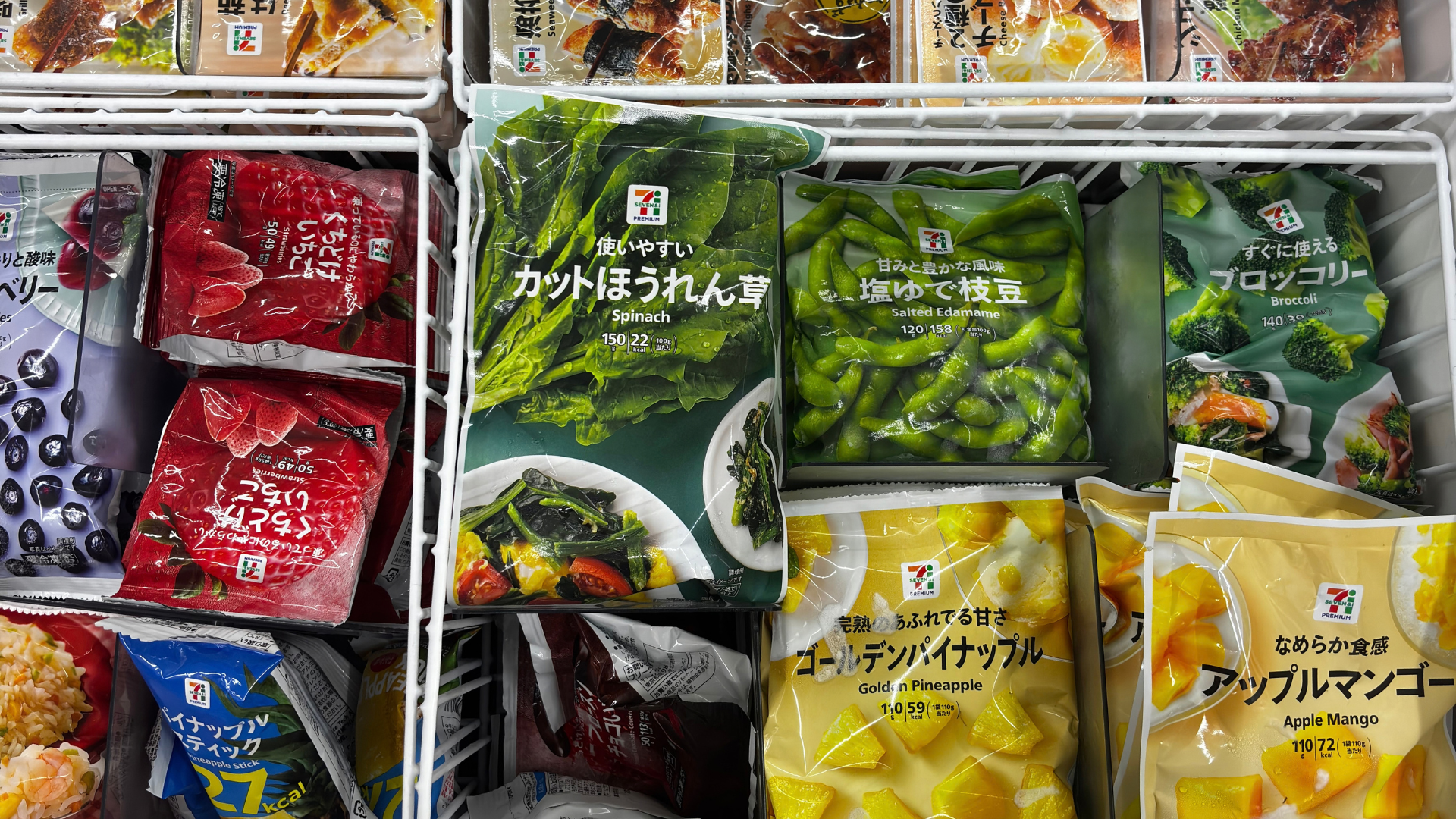
At trade shows, it’s one of the questions we hear most often: Do you do private label?
Private label brands are part of everyday life, often without much thought from a shopper’s perspective. Usually, private label brands are the price-competitive choice. Sometimes they come with a reputation for quality all their own (think Costco’s Kirkland - the #7 top brand in the world).
In Japan, private label, or private brands (“PB”), offer a unique opportunity for exporters. And if you’re a name brand, you’ll want to read on to understand how PL impacts your shelf dynamics and strategy.
Keep reading to learn:
How private label works in Japan
Private label market trends
Who is a good fit for private label
Best private label categories
How retail consolidation affects category management
Private label types: store brands, category brands, and own brands
How name brands can use PL intelligence for their strategy
Where to start
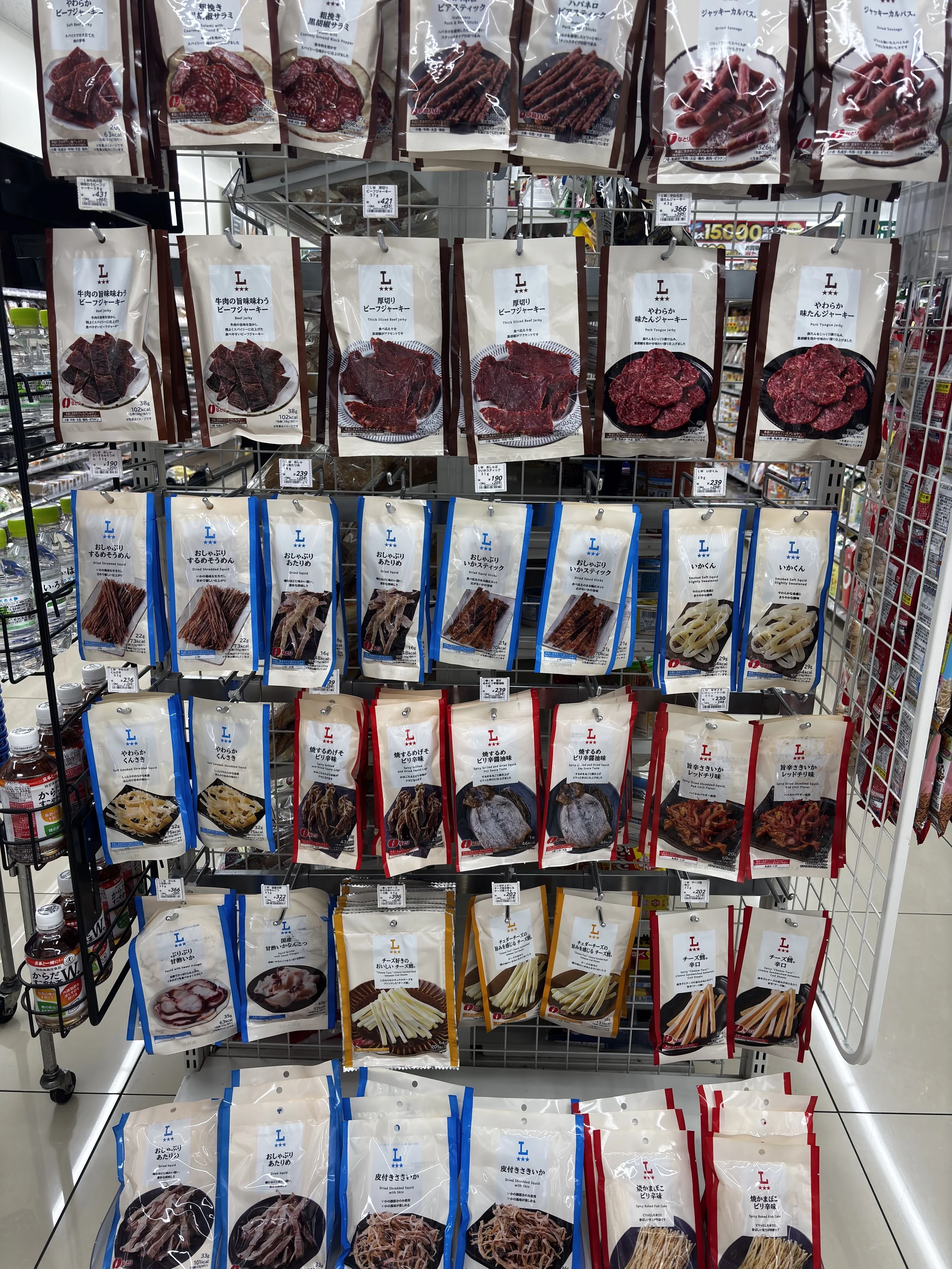
All major supermarket chains and convenience stores have their own private label brands. Go to Lawson (#3 CVS chain) and look at the beef jerky, nuts, and dried squid next to the alcohol. Lawson brand owns the shelf real estate. Most shoppers don't notice this as “private label”; indeed, it is the only choice. This is especially prevalent in Japanese convenience stores.
Japan lags other markets in private label, but that gap is steadily closing.
Compared to many other countries, Japan is far behind in its utilization of private label. But winds have been shifting among already cost-conscious Japanese consumers, which is why opportunity is growing, and exporters must understand these dynamics.
Private label holds roughly 15 to 17 percent of the Japanese grocery market (depending on your source).
We can see a clear story in the 2026 PLMA report on Europe. Private label in Switzerland accounts for over half of the market value share, with many countries close behind. Even the US, which trails most of Europe, has a higher PL share than Japan.

People are hungry for low prices. Almost literally. Japanese consumers are feeling increasing pressure from tight wages, a weak yen, and rising inflation. Grocery prices have become a national concern. Over 3,000 SKUs are rising in price as of October 2026, and the national government looks to be on the way to cutting the grocery consumption tax from 8% to 1%, effective April 2027.
At the same time, the recent wave of retail mergers means major retail brands continue to expand. Retail players are getting bigger and stronger. Large retailers have more incentive to invest in their own brands. The number of retail chains is still unusually large, and they are keen to differentiate in this still crowded market.
Whether you’re a name brand or not, it is imperative to understand that this is one route retailers can take to capture the market - both on the shelf and before shoppers set foot inside a store.
Private label offers efficiencies for exporters.
For exporters, considering private label isn’t just about price wars. Part of the appeal is efficiency. You skip much of the work of exporting a branded product: advertising, promotions, brand building, packaging localization, retailer slotting fees, etc. Forecasting is easy.
There are multiple levels to which a manufacturer can hand off products. It could be pre-weighed, packaged, and partially labeled frozen meat. Or it could be bulk cereal to be co-packed in Japan. Packing in Japan has many advantages
This can be an attractive option both for exporters new to Japan and those already here and interested in growing their reach. Stick to what you’re best at: the product. Let the retailer handle the rest.

Retail consolidation could multiply your volume.
Retail consolidation is the next factor that will work in your favor. A larger chain has more stores to spread a product across, more volume potential to offer a manufacturer, and the ability to run private label in more categories. With a positive relationship in place, you can secure more distribution through national chains with less market investment. The margin on a SKU may be slimmer, but can still be worth it considering volume, regional/national reach, ease of repeat orders, and less forecasting risk. And as chains continue to merge and expand, demand will only increase for those who have secured these lucrative partnerships.
Playing well with the store brand can win you prime shelf placement. Once you're under their brand, the retailer wants you to succeed.
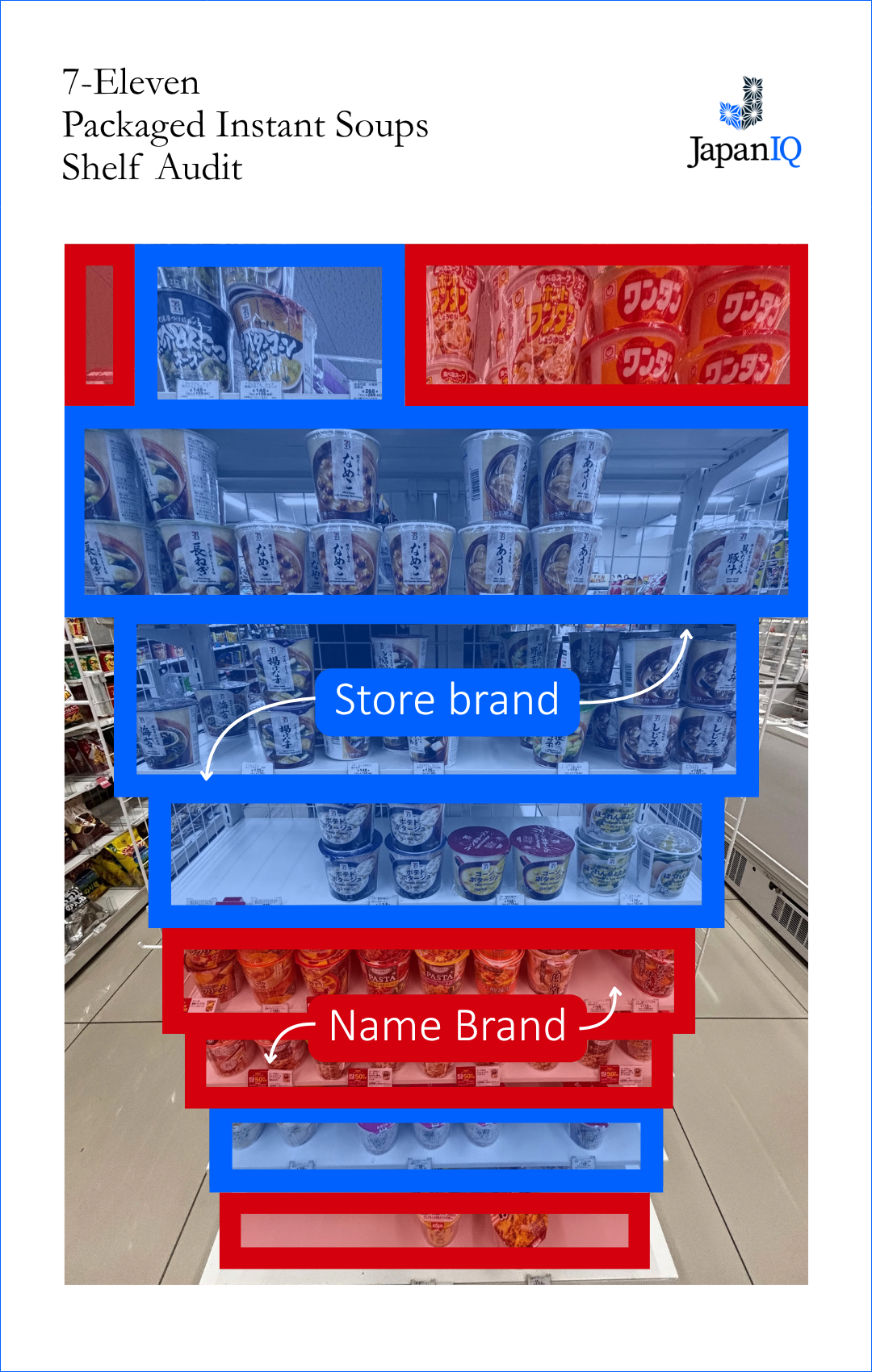
Just take a look at this unsuspecting convenience store noodle section selection. Not only are the majority of the options store brand, but they occupy the key eye-level shelf real estate used for priority products.
Working with retailers is still a long game.
This all sounds great, but just because private label offers many advantages and efficiencies doesn’t mean it’s easy. Any route you take in Japan will be slow. Depending on the retailer, from agreement day to actually getting on shelves can take anywhere from eight months to two and a half years. Discounters are on the speedier end. But highly trusted retailers like Aeon and Costco have a lot at stake when they put their name on your product. They will need to review everything; usually this includes factory audits. They will walk your production line. All quality assurance, certifications, and safety documentation must be in place. This is Japan. Be prepared to push some paper.
Expect to respond to change requests as well. Sometimes the retailer takes your existing product and only applies their in-house labels or visual brand standards. Quite often, they will get in the weeds with product development and want a different recipe, a different pack size, or ingredient swaps. For the most detail-oriented retailers, they might even require that your factory manufacturing standards change. You’ll also need to coordinate shipping and logistics. This is why shipping in bulk and packing in Japan can be easier, faster, and often cheaper than fulfilling the same requirements at your home plant.
Store brands vs. category brands
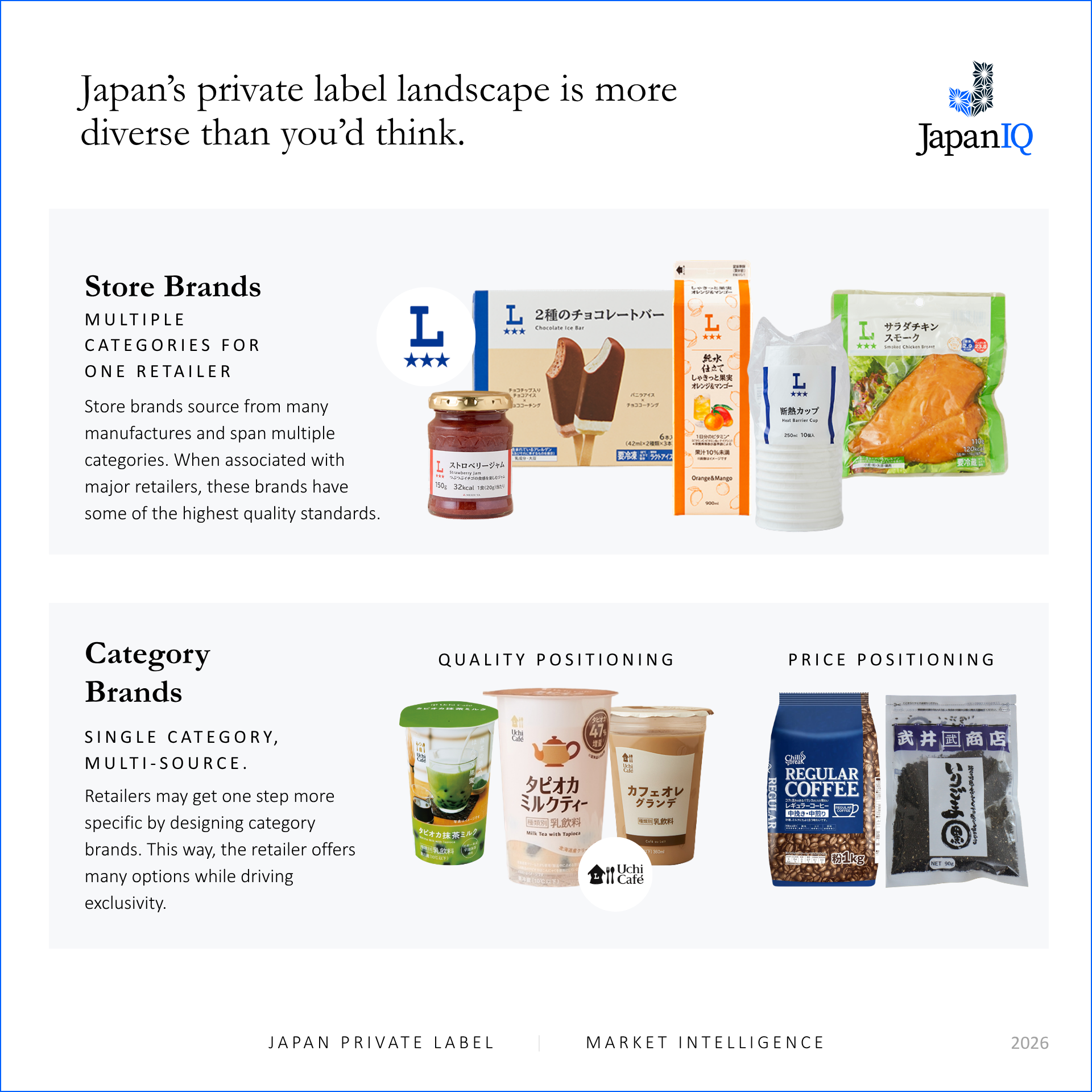
Once you get in the door, not all private labeling directions look the same. Some retailers put everything under one umbrella store brand, like Lawson brand or 7-Eleven brand. Others build separate names for each category to capture category-specific needs. Take, for example, Uchi Café by Lawson. It’s their private label brand for sweets and fine confection treats to convey a "cafe-quality" occasion at home. Or there are some category brand that capture "lowest price" needs that the name and packaging look like there is a fully branded business there, but it’s just for looks. This is common in discount stores, where there might be one snack manufacturer behind the majority of an aisle. The variety of creative, colorful packaging gives the impression of many options.
Name brands vs. private: room for both, if you play your cards right.
There are two common reasons why buyers will be especially interested in overseas products. Either the foreign product is cheaper than what they can source at home, or it's different/difficult enough that no domestic supplier can compete.
On price, Asia and Eastern Europe often have an edge, with lower labor costs. From the US and Western Europe, the pitch is more often quality, organic, or authenticity. For example, Italian food is a beloved foreign cuisine in Japan. So Italian pasta, olive oil, sauces, and tomatoes have obvious appeal. That said, there are already a hundred pasta sauces in any Japanese supermarket. Being Italian isn't enough - there still needs to be differentiation. And that differentiation needs to be successfully communicated to consumers at the shelf.
When it comes to private label, retailers want breadth; size, flavor, and texture options. Someone who can offer a full range in a category, come up with ideas, and help the buyer manage the whole shelf. If you can do that, the reward isn't just volume. You get a relationship with a retailer that makes your products the shelf priority.
The biggest takeaway for brand-forward businesses: win the categories where brand matters most.
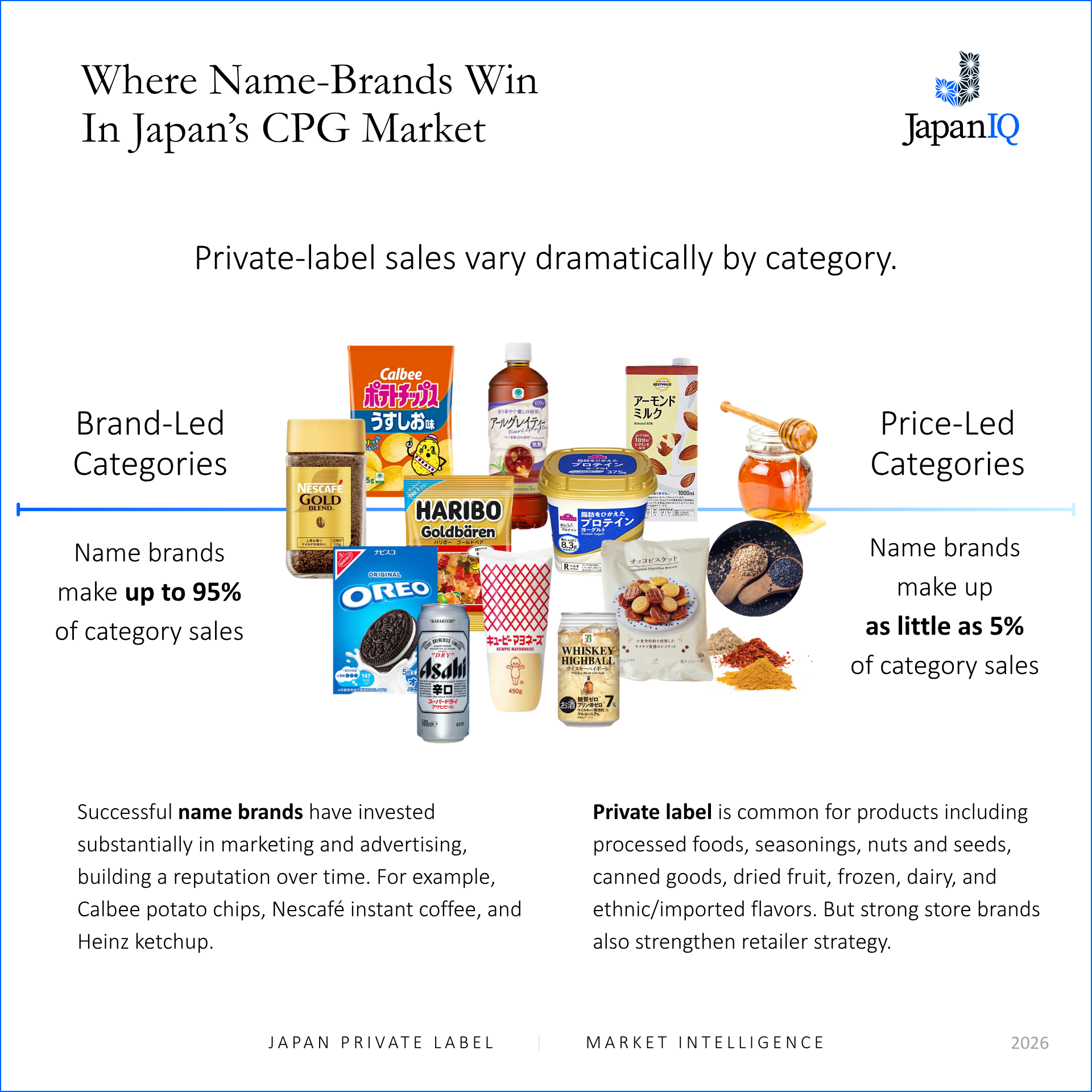
Private label intelligence is valuable for name brands, too.
We've had this conversation with our own clients, many of whom spend a lot of time and money building brands. A growing private label share indeed puts more pressure on branded products. But PL intel is critical to sharpening every name brand go-to-market strategy.
Let’s imagine you’re a cookie brand. Private label owns the cheap end. Then there's a messy middle ground of similar products at a lower price range, and then a few unique brands with a validated reason to charge more (think organic or protein-added picks). You’ve got stay-fresh packaging, a multi-generation French heritage bakery backstory, and grandmother’s recipes. You’re the #1 big cookie in France, and you come in with a whole array of options: chocolate chip, double dark chocolate, butter biscuits, sugar cookies, wafers, bite-sized, monster, and more. All of a sudden, the middle-ground players get squeezed out. Your premium brand can earn a premium price, own the metaphorical top of the shelf, and can make more money. The shelf has organized itself. The shopper is either going for the cheap option or paying more for the stand-out.
Part of the takeaway is to understand your category. From our experience, brands win in categories such as cookies, drinks, indulgent items, health and wellness, and technical products. They lose in categories that live around the perimeter of the store. Being a bona fide superior product isn’t enough. You have to prove why your product is the best… prove it with taste data, a compelling origin story, a strong home-market ranking, innovative packaging, or whatever your edge is. Put it on the shelf next to the budget picks and the existing players. Does it hold up? If the shopper doesn’t immediately understand why you deserve a higher price, they will reach for the less-expensive alternative.
How branded companies can win with private label.
And here’s the big-money intel for name brands: private label is also an option worth weighing for a name brand manufacturer. Manufacturers in the West rarely provide both a name brand product and private label on the same shelf. They usually pick one. Going for both is a strategy to be done carefully. You don’t want the store-brand to undermine premium positioning. But owning the majority of the shelf is indeed an aggressive strategy.
One of the best examples of this is Kewpie mayonnaise. It’s Japan’s #1 mayo brand. But believe it or not, they also provide “Best Price” store-brand mayonnaise. They’ve secured the shelf share and squeezed out the competition, winning both for the brand loyalty pick and when shoppers reach for the cheap option.
Just because there is significant opportunity for private label doesn’t mean brand names are out of the picture. Brands just need to be strategic within their categories and communicate a truly compelling offer.
Final thoughts: Know your category before you commit.
Whether you’re bidding to be the branded premium product choice or are more interested in retailer partnerships, private label in Japan will not be going away anytime soon.
Japan is a top target for exporters, and Tokyo alone is one of the most sought-after markets in the world. Before jumping in, you will want to understand category dynamics intimately. Once you've confirmed there's demand for your product in your category, in-person relationship management is the critical next step.
Private label won't take over Japan's shelves overnight, but with prices rising, retailers consolidating, and shoppers watching every yen, it's undeniably growing. For exporters who want a route into Japan that avoids building a brand from scratch, it can open doors to national distribution. For name brands, it's a signal to sharpen your story and compete where brand matters most.
Either way, the path is long and nuanced, so start by understanding how your category works. Where do private labels win? Where do brands hold their ground? Once you know where you fit, the next step is relationships, and in Japan, those are built in person.
I’ve spent over 18 years navigating Japan's market on the ground - first inside global CPG, then on my own. I led packaged goods for Starbucks in Japan, held a senior role at Nestlé, and drove HARIBO from a fringe player to the #1 gummy brand in Japan. Now with JapanIQ, we are putting that experience to work for other companies, advising clients that range from global food brands to small challengers, government delegations to full in-market representation. We can help assess market fit, develop go-to-market strategies, facilitate business matching, coordinate co-packing, and act as your local liaison team.
JapanIQ is a network offering market intelligence, retailer relationships, local representation, and more. Since we’re actively representing an established client base, we’re regularly face-to-face with wholesalers, distributors and retailers. We are the industry leaders helping to navigate both name brand and private label; decades of experience in Japan.
Ask us whether you're in a category where a brand can hold a premium, or if a private label partnership might be your open door. PL is one route among several, and the right track for you depends on your product. But the retailers are our network, the co-packers are people we know, and our team has experience as the retailer managing private label. We know what the buyers will be looking for because we’ve been there.
If you are curious about your options, or perhaps you’re already in Japan and need proper help. Don’t hesitate to reach out.
Paul J. Kraft