
The Juicy Truth About Japan’s Food Industry: Wholesalers in a Fragmentation Nation
Surprise! Even with increased M&A in the grocery space, wholesalers are still incredibly relevant in Japan, and you’re going to have to deal with them. Here’s why.
Dear Exporters, Welcome to the Wild West East.
In Japan, business is like a game of chess… multi-layered, human-to-human, deliberate, and can feel devastatingly slow to someone from Germany, USA, Canada, Australia, or other Western countries. A careful pace is most apparent here in Japan, working with grocery and consumer packaged goods, where the role of the wholesaler is unavoidable and essential.
And while merger and acquisition activity among supermarkets has notably increased, the wholesaler and their holding companies will stay involved. Indeed, if your brand has an aspiration to be "national" in Japan (a topic for another article), you are going to have to deal with wholesalers.
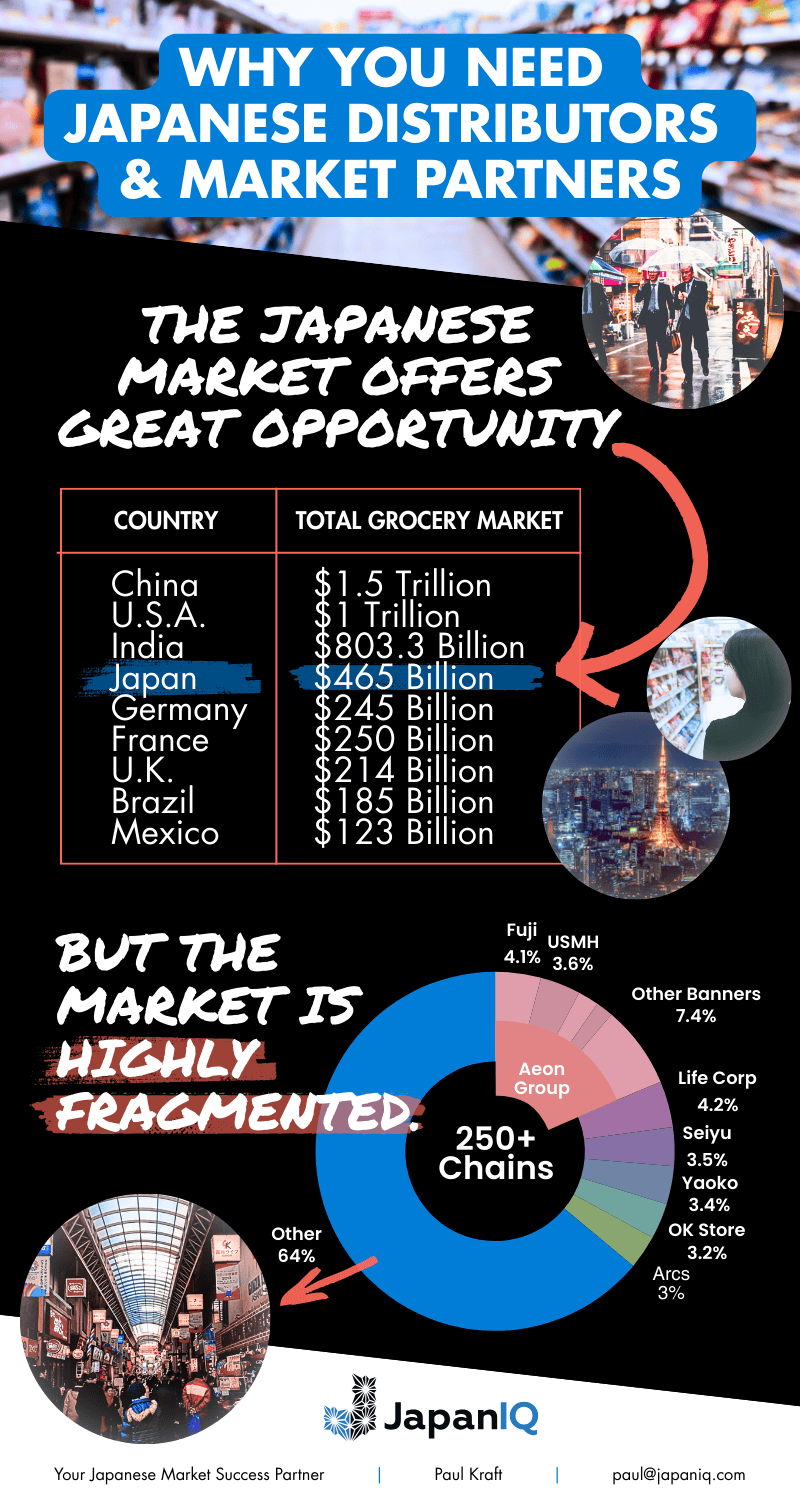
Unlike many commercialized countries, where five or six national grocery chains dominate most of the market into one big, homogenous field, Japan has over 500 separate grocery chains (none with more than 9% market share). It’s a unique scenario that allows smaller chains to stay operational. The whole system was designed to serve smaller chains (especially in buying and logistics functions). But this intense fragmentation means systems aren’t consolidated. They operate regionally. Retailers at this smaller scale never had to invest much in IT, logistics, warehousing, purchasing functions, back office, etc. They rely on these services and infrastructure as supplied by wholesalers.
And this regional specialization (and local focus) is still deeply embedded, even in Japan’s largest retailers. Take Aeon, for example. Aeon is the biggest grocery retailer in Japan, but if you want to get your products into all Aeon stores or across all Aeon banners, you’ll still need a large, regionally based sales team.
There are separate buying groups for Aeon in Kyushu, Hokkaido, Tohoku… you name it. So even though Aeon might represent a big chunk of the market on a pie chart, actually reaching all those stores requires a lot of people, coordination, and multiple points of contact.
Compare that to a retailer like Walmart, where a single buyer might cover most of the U.S. market. It’s a completely different model.
In Japan, if you want to go national in scope, you will need to do it the Japanese way. Swim with the current. Work with Japanese wholesalers.
The wholesaler landscape is its own jungle. Wholesalers are logistics providers, relationship managers, and brand managers for thousands of stores. Even in other channels where we’ve seen mergers (such as convenience and drug stores), wholesalers still play a role. For example, major drug store fixture, Welcia, still doesn't run its own trucks.
Because of wholesalers, local shops and small regional chains (often with fewer than 30 stores each) are able to stock the breadth of SKUs needed to compete or meet the diversity of local demand.
What this means for you: if you're looking to launch your product in Japan and think you can go direct to the big box buyer, take heed. You can go direct to retailers, but the human capital required to scale typically won’t align with foreign expectations. With few exceptions, it’s simply not sustainable. You have to play the game. Welcome to the Japanese distribution jungle.
Wholesalers: the Guardians of Regional Flavors & Cultural Preservation
Sure, wholesalers are middlemen who take a cut. But they’re also enablers and guardians of a highly important facet of Japanese food tradition: regional flavors and specialties. Japan’s cultural, culinary, and emotional geography is stitched together by people who sit in offices and boardrooms, deciding what food products go where. Who enters. Who heads to shelves.
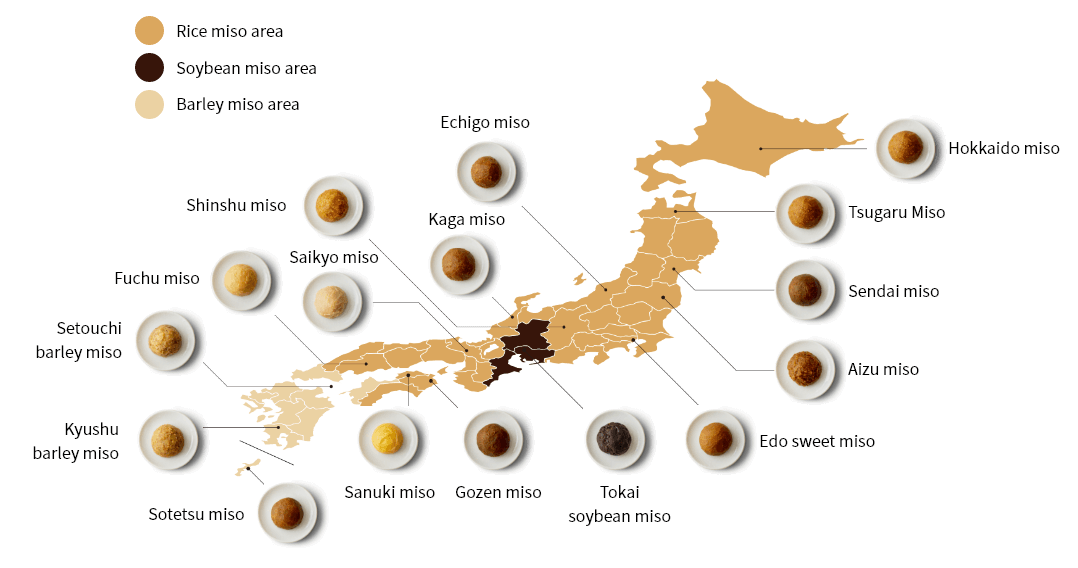
Walk into a grocery store in Kyushu, and you’ll find more varieties of senbei (rice crackers) than you’d ever see in Tokyo. In Ehime, everything tastes a little sweeter, including the soy sauce and miso. These aren’t quirks; they’re expectations born from centuries of regional pride and local tradition. The wholesaler industry understands. They enable the preservation of flavor borders. This meets expectations for both local consumers and touring shoppers.
Japan’s Regional Miso Variations Map
Source: Umami Information Center
Wholesalers have long-standing relationships with small manufacturers and know what each micro-market demands. They’re curating essential foods for deeply ingrained palates, not so much trend-chasers.
This kind of cultural granularity has all but disappeared from Western grocery experiences, where mass retail has essentially paved over local flavor in favor of efficiency and scale. But in Japan, the wholesalers’ lack of desire to consolidate, their tradition-bound relationships, and their aversion to change all preserve something precious.
Forever Outsider-Weary, Even for Japanese Neighbors
Precious, sure, but to an exporter looking to sell across Japan in as few moves as possible, this is all just a big nuisance. It’s the complaints I hear time and time again. Why can’t I just go straight to the big retailer. This wholesaler is too slow, we need a new one. I don’t want to share a cut with them, why do we even need them!
To understand how Japan does business, you have to understand how Japan does people. This is a country shaped by over 200 years of closed borders in recent history alone: geographic, political, and social.
Isolation wasn’t just policy during the Edo period. It became cultural muscle memory. Even after international borders opened (and perhaps especially when international borders opened), Japan remained wary of outsiders… even of other Japanese from neighboring prefectures. Many expect weariness towards foreigners. But know that this same skepticism exists between regional neighbors, even when everyone at the table is Japanese.
And this deeply rooted regionalism still informs modern business. Relationships and proximity matter more than flashy credentials or international success. Loyalty is built slowly, over years, through repeated small acts of trust. Face-to-face matters. Familiarity matters. Risk-taking is bad!
In practice, that means wholesalers aren’t just vendors. They’re known actors in a world that values predictability. They go back generations… “My grandfather bought tomatoes from Tanaka distributors” is a reason that still carries real weight. And it’s one of the reasons why trying to disrupt the system by going around these middle players will backfire. Spectacularly.
This isn’t just about business strategy. It’s about social rhythm. It’s about reading the room in a place where the room starts at the city limits.
Whether you agree with it or not, people prefer to operate within familiar, established regional groups here. So if you want your product to span Japan, it’s going to take relationship management with multiple groups at multiple levels. That might mean having a lot of meetings that feel slow and superfluous. It might look like having a representative like me hop a train to Osaka to be face-to-face with the people who can slot you into the Kansai region. It might mean sticking the course for three years instead of three months. It’s a different game. A long game.
Embrace a New Pace in Japan.
For foreign brands, this can be maddening.
You don’t get to pitch your product directly to the buyer. You don’t get fast decisions or clear answers. You don't get to blow through red tape with a killer deck and a confident handshake. You go through the wholesaler, who likely never needed to talk to you in the first place. An uphill battle.
But here’s the thing: The wholesaler is not the enemy. Sure, they are a gatekeeper. And sure, they're risk-averse. But they are the insiders. They’re the key.
The innovations and brand stories you used back home likely won’t sway a wholesaler. They care about consistency, logistics, inflation, and the preferences of their long-time retail customers. You have to stick with them.
And moving too quickly confuses the market. It’s like carrying a tray of wine glasses. You can go anywhere you want. But don’t let anything slip, or you’re in for disaster.
If you change your direction too quickly, your partners won’t know if they’re getting the best deal, if they’re working with the right person, or if the product they’re getting is even the top-tier, inspected version.
Now, I’m all for pushing boundaries. But you have to do it intentionally. If you send too many conflicting signals into the market, it can make buyers nervous. The market gets skittish, and your product can start to lose traction, not because of quality, but because of confusion.
And in Japan, switching wholesalers too fast can irreparably damage trust. That saying “It’s not personal, it’s business” doesn’t apply here. Not. At. All. Not for one second. Ending a partnership means you’re closing a door you can’t reopen.
So mourn your preference for Western speed - I understand and sympathsize. Let go of your hunger for instant wins. Embrace the long game. Enjoy the ride. Grab a famichiki while you wait.
Buckle Up for the Long Haul with the Right Distributor
Understanding Japan’s wholesale system isn’t optional if you want to succeed in this market. It’s not broken. It’s working exactly the way it’s supposed to. It’s different, complex, and intricately tuned. And for all its constraints, it protects something Western business often forgets: a sense of place, of loyalty, of cultural flavors that don’t scale.
If you're coming to Japan with a product and a dream, don’t just find a distributor.. find your match! Bring humility, data, strategy, and someone to help. Move like you’re balancing a tray of wine glasses. And remember: in a country where loyalty is currency and tradition shapes every shelf, the slow route is often the only one worth taking. (By the way, you never had a choice anyway).
Breaking into Japan is tough, no question, but it’s absolutely doable. I’ve spent over 20 years in the trenches here, navigating every cultural curveball and business quirk you can imagine. Here’s the thing: bridging the gap between cultures isn’t just a skill; it’s a strategy. And when it works, the rewards are substantial. I’ve helped companies punch above their weight and achieve serious growth in Japan. It’s not easy (nothing worthwhile ever is!) but there’s nothing more satisfying than beating the odds in one of the toughest markets on the planet. If you’re hitting roadblocks in Japan, reach out. Let’s solve it. That’s what I do.
Paul J. Kraft